A Weekend of Service in Wisconsin
A Q&A Interview About Volunteering with Remote Area Medical
Karen: How was your trip to Wisconsin?
Dave: It was good. I had a great time. My travel plans got a little complicated, and I ended up spending an extra day in Charleston, but I still made it to Wisconsin in time for my volunteer assignment with Remote Area Medical.
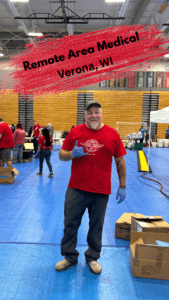
Karen: You went into this without many expectations. You had seen the 60 Minutes segment about Remote Area Medical, but what was it like when you arrived?
Dave: Everyone was very welcoming. The staff was prepared to put me to work right away, but I explained that I had already been assigned to work in the parking lot from 10:45 p.m. until 5:00 a.m.
They said, “We’ll see you at 10:45,” and then introduced me to a couple of the parking lot leads, Ted and Lindsay. They were very nice and said they looked forward to seeing me later that night.
Karen: What was your first assignment?
Dave: Remote Area Medical assigns volunteers to the parking lot the night before each clinic because patients often arrive early. Some people travel long distances, and the earlier they arrive, the more likely they are to receive the care they need. Some people even arrive a couple of days ahead of time and camp in their cars.
As a general support volunteer, I had indicated that I was willing to work overnight in the parking lot. Having watched the 60 Minutes story, I knew it was an important job that needed to be done.
Karen: How many volunteers were working with you?
Dave: There were five and a half of us! One person was the the lead and wasn’t supposed to stay all night, but she remained with us until about 2:00 a.m. There were also four other people and me.
Our job was to greet the cars as they arrived, find out how many people were seeking services, and ask which additional service they needed.
Every patient received general medical care. They could also choose either dental or vision care. If there was enough time, some of the patients who arrived early could get back in line and receive the other service as well.
Karen: How many people arrived during your shift?
Dave: We checked in 47 cars with more than 100 occupants. Entire families would arrive with several people needing medical treatment.
About 90 percent of the people we checked in requested dental care. The demand eventually exceeded the clinic’s capacity based on the number of dentists available, but the team still worked very hard to get everyone seen.
Karen: What was the clinic operation like? Did everything seem to run smoothly?
Dave: The clinic didn’t officially open until 5:45 a.m. My overnight shift ended at 5:00 a.m., so I didn’t see the clinic open that morning.
I had checked in with one of the lead doctors the evening before because my Sunday assignment was listed from 5:00 a.m. until 6:00 p.m.—immediately following my overnight shift. I explained the situation, and she told me to go home at 5:00 a.m., get some sleep, and return at 11:00 a.m. to help tear down the clinic.
By the end of the weekend, they had treated 337 patients. The estimated value of the medical, dental, and vision care provided was more than $245,000.
They had expected around 100 patients, so serving 337 people was considered a huge success. They treated approximately 200 people on Saturday and nearly 150 more on Sunday.
This was Remote Area Medical’s first free clinic in Wisconsin. The Wisconsin Secretary of Health visited on Saturday, toured the clinic, and said it was something the state would like to support and see offered again.
Karen: What did the clinic look like?
Dave: It was held inside a large indoor track-and-field facility. There was a welcoming area, a pre-screening area, and separate sections for medical, dental, and vision care.
The treatment spaces were created with pop-up canopies and fabric walls, making them look like individual medical and dental suites. It was impressive to see how they transformed the building into a working clinic.
Karen: What did you do when you returned on Sunday?
Dave: One thing I really appreciated was that each time I checked in, the first question from the coordinators was, “Are you hungry?”
Because I had slept from about 5:00 until 11:00 that morning, I hadn’t eaten. They made sure I had a sandwich and some pulled pork before sending me to the clinic area.
I started by helping take down the welcoming and screening areas. We put away tables, chairs, supplies, and some lightweight medical equipment.
When that work was finished, I found the dental lead and asked what I could do next. They put me to work dismantling the portable dental setups. These stations receive compressed air and water, allowing dentists to perform procedures in a temporary clinic setting.
Karen: How many dental stations were there?
Dave: There were more than 20 dental stations. I had imagined there might be only four or five, so I was surprised by the size of the operation.
Each portable unit was about the size of a carry-on suitcase. It had five primary components that had to be disconnected, bundled, folded, and packed away. I became pretty good at taking them apart and probably dismantled around a dozen of them fairly quickly.
Because I’m mechanically minded and familiar with that type of equipment through my work, I was then asked to help dismantle the utility systems. That included the compressed-air lines, air-conditioning lines, water lines, the main compressor, and the manifolds that distributed air and water to the individual dental stations.
By the end, I had helped take down most of the compressed-air system.
Karen: If there were more than 20 dental stations, why couldn’t they serve everyone who requested dental treatment?
Dave: The limitation wasn’t the equipment—it was the number of dentists.
They had dental hygienists who could perform cleanings, so many people were still able to receive preventive care. However, there weren’t enough dentists available to provide all the advanced treatment that was needed.
Karen: What was one of the simplest services you saw someone receive?
Dave: Probably a routine dental cleaning. Those of us with dental insurance may be able to receive a cleaning every six months, but many of the people attending the clinic had probably gone without one for a very long time.
Something as basic as a cleaning can make a real difference when someone hasn’t had regular access to dental care.
Karen: What was one of the most advanced procedures performed?
Dave: On Saturday, one of the dentists successfully extracted all four wisdom teeth for one patient right there in the temporary clinic.
I don’t know all the details, but I assume the dentist used a local anesthetic, similar to what might be used for other tooth extractions.
Karen: Did you hear any memorable stories from the vision clinic?
Dave: Yes. One woman had needed a new eyeglass prescription for about 18 months. Her only pair of glasses had broken repeatedly, and she had been holding them together with a large amount of tape.
At the clinic, she received an updated prescription and two new pairs of glasses at no cost. She was smiling in the “before” photo, but her smile was even bigger in the “after” photo.
It was wonderful knowing that people received care they truly needed—whether it was a cleaning, relief from dental pain, medical treatment, or the ability to see clearly again.
Karen: Would you volunteer with Remote Area Medical again?
Dave: I would. I’ve already looked at some of their upcoming clinics. There is one in Anchorage, Alaska, in September, although that would be quite a flight.
They’re also scheduling clinics in Kentucky and Tennessee for next year, along with locations in Pennsylvania, Ohio, and New York. I haven’t seen another clinic announced for Verona yet, but based on the success of this one, I’m confident they’ll return to Wisconsin.
Karen: The big question—did you get your volunteer T-shirt?
Dave: I did! It’s in the laundry right now.
Karen: Good job, honey. Thank you for doing good things.
Dave: Thank you. Why not?